5-Minute Pearl · Haemostasis
The Anti-Xa Assay
Test principle, indications, performance, interpretation and the next clinical step for FRCPath and FCPS revision.
The pearl in one sentenceAn anti-Xa result is meaningful only when the anticoagulant, calibrator, sample timing and local decision range are known.
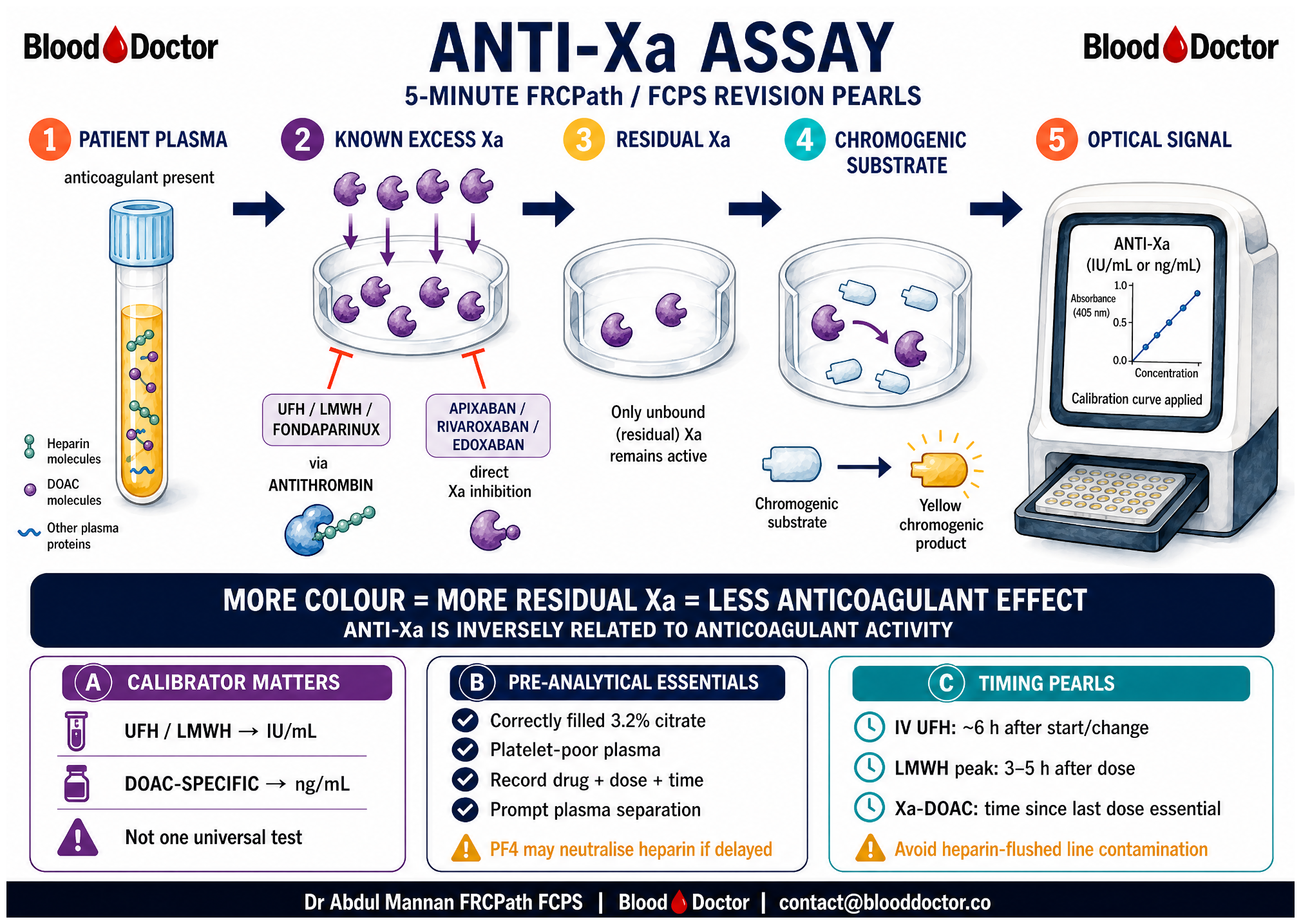
1Test principle
The anti-Xa assay is a chromogenic functional assay, not a clotting-time assay. A known excess of factor Xa is added to patient plasma. Anticoagulant in the sample inhibits a proportion of Xa; residual Xa cleaves a chromogenic substrate, generating colour.
More colour means more residual Xa and less anticoagulant effect. The optical signal is converted into a result using a calibration curve appropriate to the drug being measured.
| Calibration | Meaning | Typical unit |
|---|---|---|
| UFH or LMWH | Heparin-mediated Xa inhibition | IU/mL |
| Fondaparinux | Fondaparinux effect | Method-specific |
| Apixaban, rivaroxaban or edoxaban | Drug concentration | ng/mL |
2Indications
- UFH: use anti-Xa where APTT is unreliable, including lupus anticoagulant, high factor VIII, baseline prolonged APTT or discordant results.
- LMWH: selective monitoring in severe renal impairment, pregnancy, extremes of body weight, paediatrics, unexpected bleeding or recurrent thrombosis.
- Xa-DOAC: quantify with a drug-specific assay for major bleeding, urgent surgery, possible thrombolysis, overdose, accumulation or suspected non-adherence.
Do not use anti-Xa to assess dabigatran. It is a direct thrombin inhibitor and needs a thrombin-based assay.
3How to perform it
- Use a correctly filled 3.2% citrate sample and produce platelet-poor plasma according to local method.
- State the anticoagulant, dose, route, last-dose time, sampling time, renal function and clinical question.
- Avoid heparin-contaminated lines. Process promptly: platelet factor 4 can neutralise heparin in delayed samples.
| Treatment | Timing principle |
|---|---|
| IV UFH | Usually around 6 hours after starting or changing infusion, then use local nomogram |
| Therapeutic LMWH | Peak usually about 3–5 hours after dose, ideally at steady state |
| Xa-DOAC | Record the exact time since the last dose |
4Interpretation and what next
For UFH, many institutions use 0.3–0.7 IU/mL as a working therapeutic range, but the local validated assay and nomogram govern dosing. A low result requires confirmation of timing, delivery, sample source, dose and recent drug exposure before escalation. A high result requires bleeding assessment, contamination review and action through local protocol.
LMWH results must be interpreted against the specific preparation, dose regimen, indication and sampling time. A DOAC concentration informs an urgent clinical decision; it is not a universal dose-titration target.
5Rapid-recall cards
Tap or click a card to reveal the answer. Tap again to test yourself once more.
6Errors and troubleshooting
| Unexpected finding | Possible cause | Safe next action |
|---|---|---|
| High heparin anti-Xa from a line sample | Heparin contamination | Repeat from a clean sample before changing dose if clinically safe |
| Low result after delayed processing | PF4-mediated heparin neutralisation | Repeat using promptly processed platelet-poor plasma |
| High result just after UFH starts | Residual Xa-DOAC | Use the local transition strategy and investigate interference |
| Undetectable result but anticoagulant effect suspected | Dabigatran or wrong assay | Request the appropriate thrombin- or drug-specific assay |
Exam checklist
- Which anticoagulant is present?
- Which calibrator and unit were used?
- When was the sample taken?
- Could the specimen or assay be interfered with?
- What decision will this result change?
For education only. Follow local laboratory and anticoagulation protocols for patient-level decisions.
Next in the series
Basic coagulation tests — PT · APTT · TT · Fibrinogen. What each test measures, the pattern each disorder produces, and how to read a mixing study.